Characterizing non-linear patterns in range shifts through time

Species ranges are shifting in response to climate change. It is expected that species ranges will move poleward to track their climate envelope, but ranges are non-contiguous. Different edges of a range may shift in different ways and at different rates, creating non-linear patterns.
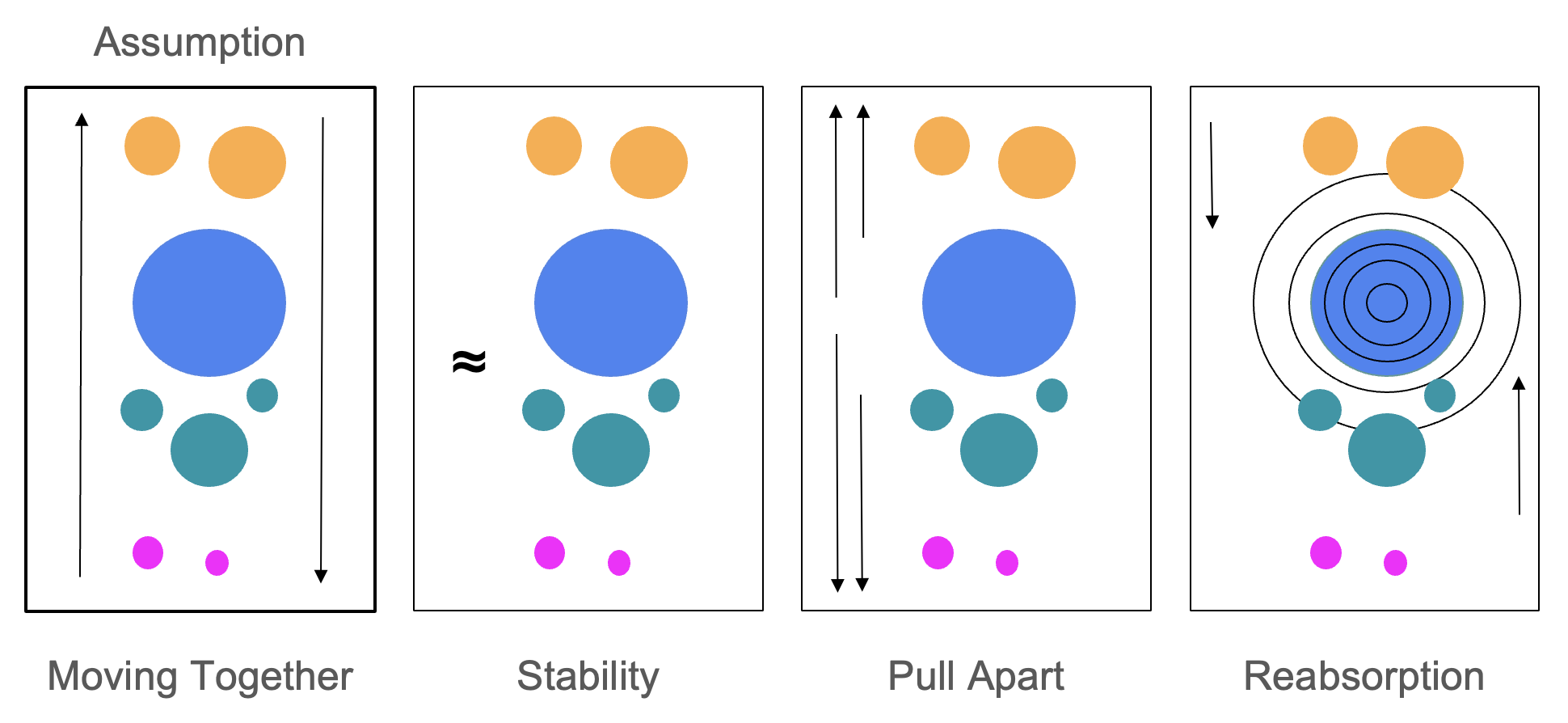
Non-linear dynamics dominate in tree species, but are largely stochastic

Using the Python package ecospat to identify the range edges of 83 North American tree species and their movement from the 1960s to 2025, we found that only 15.3% of species had expanded poleward, while the majority (58.3%) of species exhibited non-linear (i.e., pull-apart or reabsorption) dynamics. While stability versus movement was evolutionarily conserved, the types of movement was not. Further, movement types were not explained by differences in historical versus modern environmental variables, suggesting that range dynamics are largely stochastic.

While the majority of students only consider range shifts, expansions, or contractions, there many be other elements of a species range that matter, such as shape or patchiness 1. However, we are limited by human proclivities in what we consider important for range dynamics.

Using heterogenous graph neural networks to characterize temporal shifts in North American bird ranges

Harnessing the power of eBird occurrence data and AI, we are using heterogeneous graph neural networks (GNN), Neural Ordinary Differential Equations (NODEs), and the environmental, phylogenetic, temporal, and spatial relationships of 75 bird species with year-round ranges in Tennessee to: 1) learn what aspects of a range matter for spatial dynamics and characterize patterns of range movement through time and 2) create a continental-scale generative range environment from which fine-scale digital twins of areas important to Tennessee ecosystems will be instantiated and manipulated (e.g., population collapse, altered spatial connectivity, novel climates) to test hypotheses in silico and optimize management decisions in the real world.


Deliverables

Funded by the Tennessee Human-AI Readiness & Innovation (THRIVE) initiative.

Patterns and Drivers of Temporal Range Shifts

We are examining the learned node and edge representations, as well as the attention weights, from the heterogeneous GNN to predict species range dynamics and identify the ecological and evolutionary drivers of these dynamics. Feature attribution is used to quantify the relative importance of spatial, environmental, phylogenetic, and trophic relationships in driving observed range shifts. Latent trajectories generated by the NODEs, are clustered to identify distinct patterns of range dynamics through time and visualized to validate the ecological basis of clusters.

Digital Twin of Seven Islands State Birding Park

We are constructing a digital twin of Seven Islands State Birding Park by building a local Conditional Variational Autoencoder (CVAE) tailored to park-specific features. The CVAE encoder integrates species distributions observed at the park via an eBird “hotspot”, the latent states and trajectories learned by the heterogeneous GNN with NODEs framework, and environmental and management variables specific to the park. State land managers from the Tennessee Department of Environment and Conservation (TDEC) can manipulate conditions in this latent space to explore the outcomes of habitat and species management strategies, such as adding hunting areas, adjusting protected zones, or altering fire regimes, and evaluate how these actions shift species distributions.

Educational Game

We are creating an online educational game and web application inspired by The Fiscal Ship. This game will allow students to explore where birds live and how this can change, understand the factors that shape these distributions, and experiment with strategies used in the real world to help manage them. Given a management budget and goal, students can select to manage for habitat (e.g., planting grasslands or using prescribed fire to maintain early successional communities), manage for species (e.g., altering hunting areas or rearing and releasing individuals), implement policy strategies (e.g., land acquisition), and more.