A General Model of Discretized Rarity
We introduce a general model of discretized rarity (GDR) that incorporates geographic, functional, and phylogenetic dimensions at regional and local scales. This model can be simplified based on research question, management goal, spatial scale, and data availability to create workable definitions and link existing approaches.
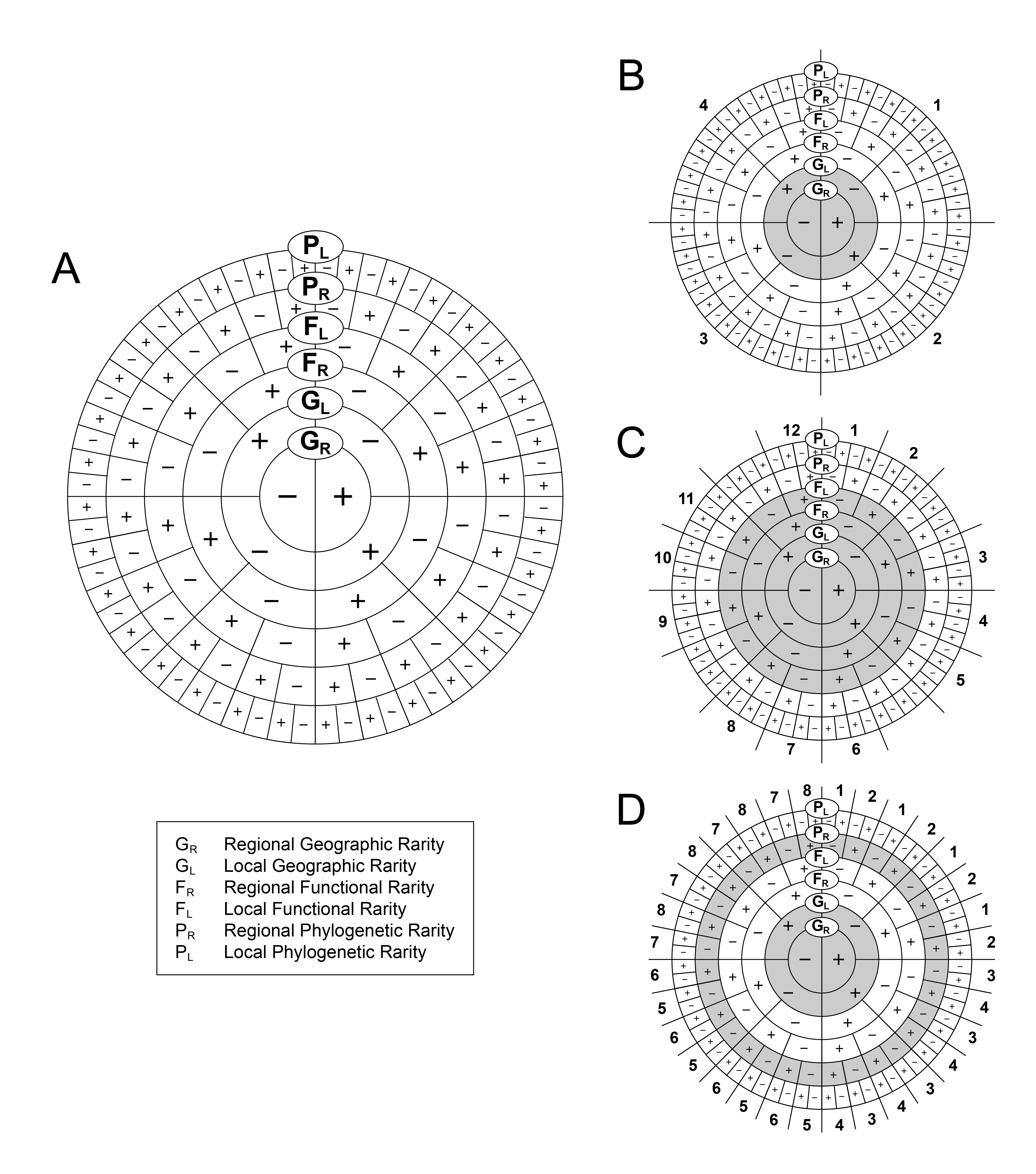
The GDR includes 64 novel and existing definitions of rarity
The general model of discretized rarity encompasses many different definitions of rarity and can be visually interpreted similarly to a codon table. Interestingly, because these different definitions are all simplifications of the same general model, they can be compared directly using the R package GDRarity in their ability to explain biology.
Rarity explains variation in distribution change and flowering phenology
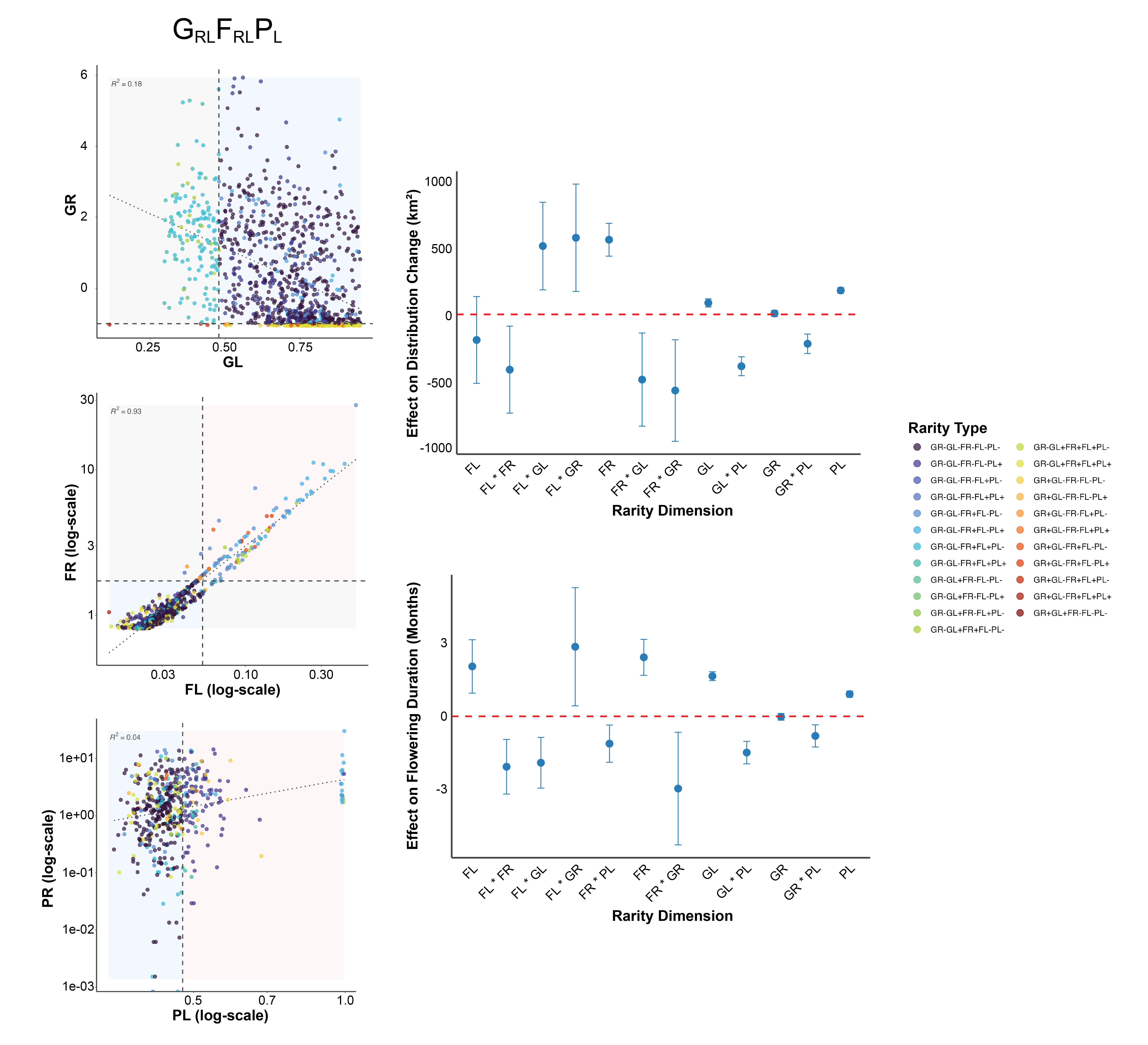
When applied to 1,011 British plant species, the most comprehensive sub-models (i.e., those characterized by high multidimensionality in rarity) of the GDR performed best at explaining biological processes, such as flowering phenology and distribution change over 32 years. While rarity is often used to classify species, these results demonstrate that rarity can also be used to understand broader ecological processes. This raises an important question: should rarity be defined by multidimensional completeness or by its ability to explain important biological patterns?
The role of rarity in communities and ecosystems is likely complex because the interactions between rarity dimensions are equally complex
Rarity dimensions interact, such that the effect of any single dimension on biological and biogeographic variables depends on whether other dimensions are also present. Therefore, how we understand the impacts of rare species on community structure and ecosystem function will vary by community and across the landscape. Addressing this complexity will require novel experimental designs that better capture the contribution of multidimensional rarity. The GDR and its novel simplifications offer a new set of tools to integrate rarity across diverse research and conservation efforts to address new questions and generate novel hypotheses tailored to specific goals, scales, and data availability.